
T1D Scout Early Detection
& Support Program

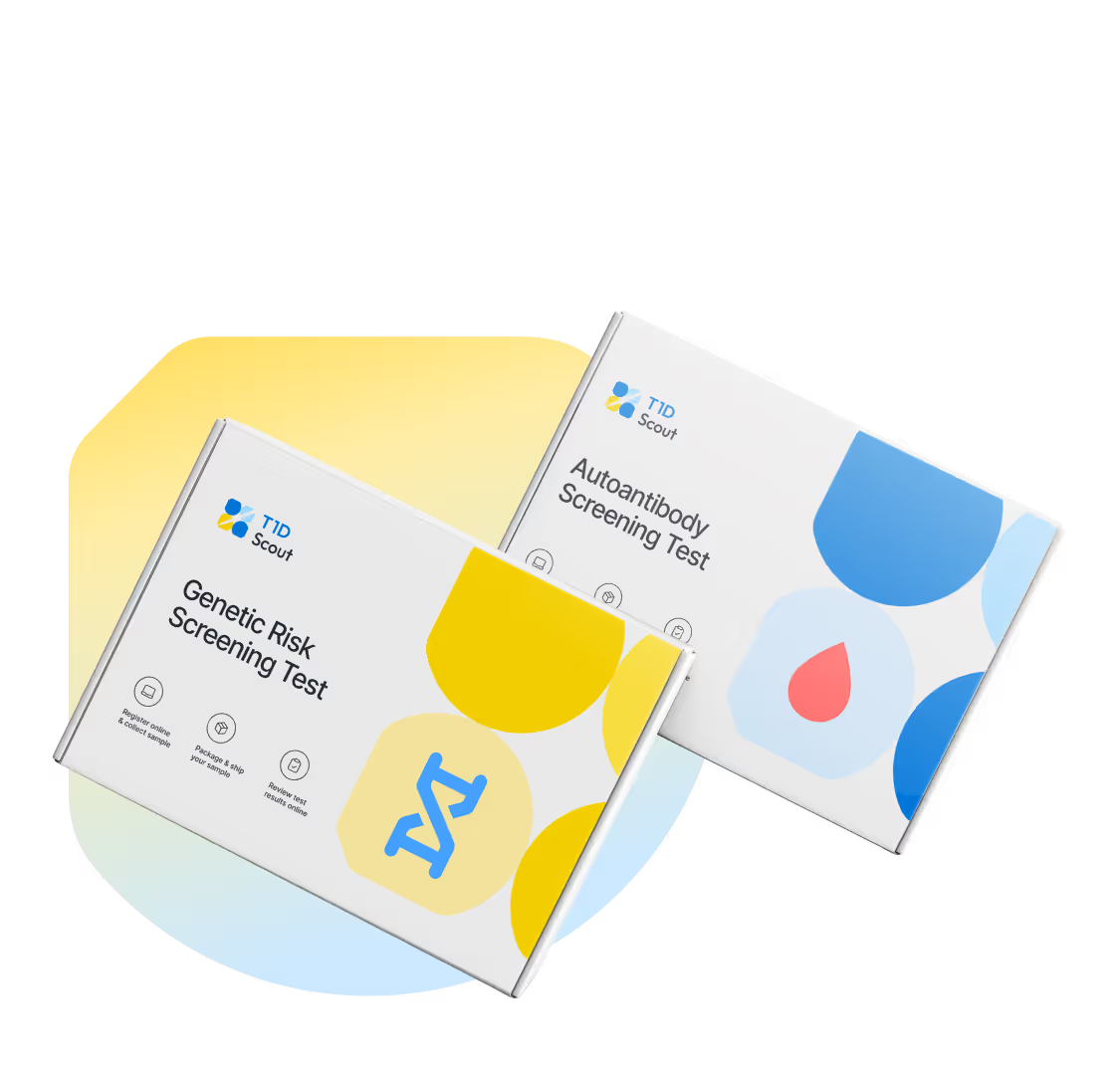
At-home

Saliva-base

No needles

.avif)
How it works
Everything will be done at home — no visits required
Step 1
Simple start & Initial screening

Join T1D Scout for FREE
Create account. The parent registers as the account owner.
1.1FREE
Add program participants
Children, family members, yourself, or others
1.2FREE.avif) 1.3
1.3Order the DNA test(s)
Individual saliva-based DNA test test for each participant. You can track the status in your account
Step 2
Your personalized path
 2.1FREE
Register & manage result
Children, family members, yourself, or others.
 2.1
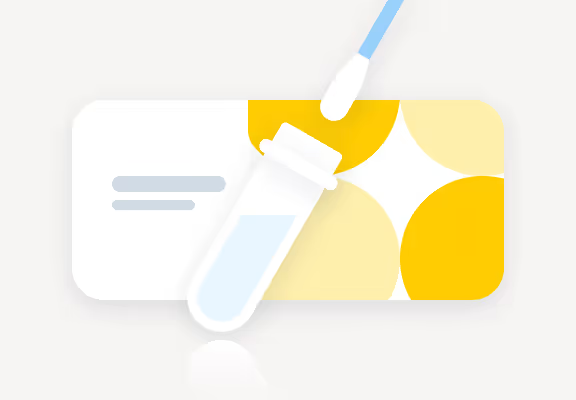
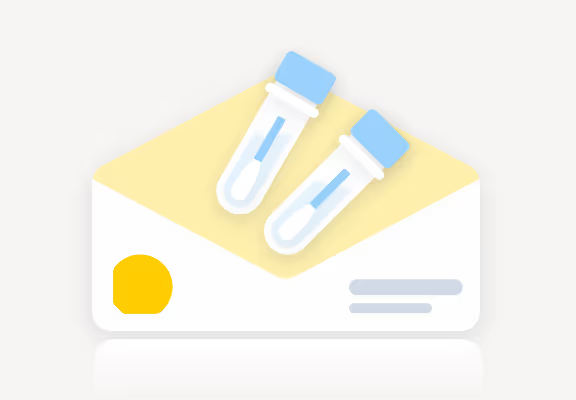
2.1Collect your sample & Send the package
Collect the sample by following the instructions inside the kit.
 2.1
2.1Send the package
Pack and send the package with your sample to the lab. We will notify you when it’s ready.
 2.2
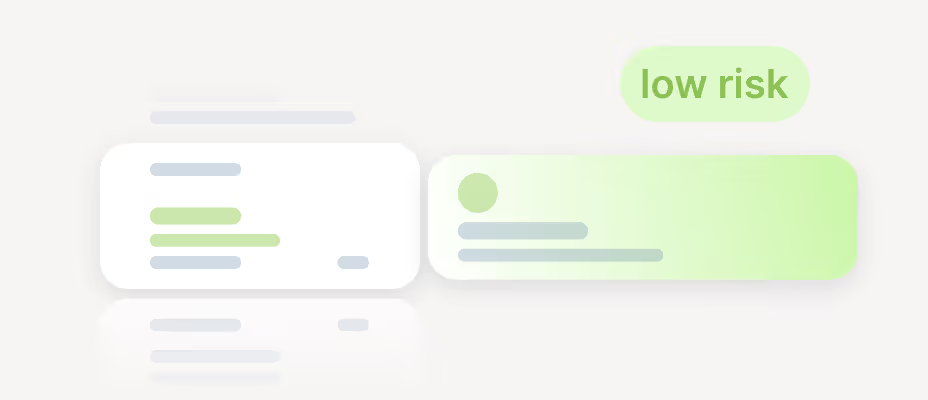
2.2If low risk
A lower-risk result means the genetic markers we analyzed do not currently suggest elevated risk but this does not rule out T1D. If you have a family history — you may talk with your doctor about whether ongoing autoantibody monitoring is right for you.
 2.3
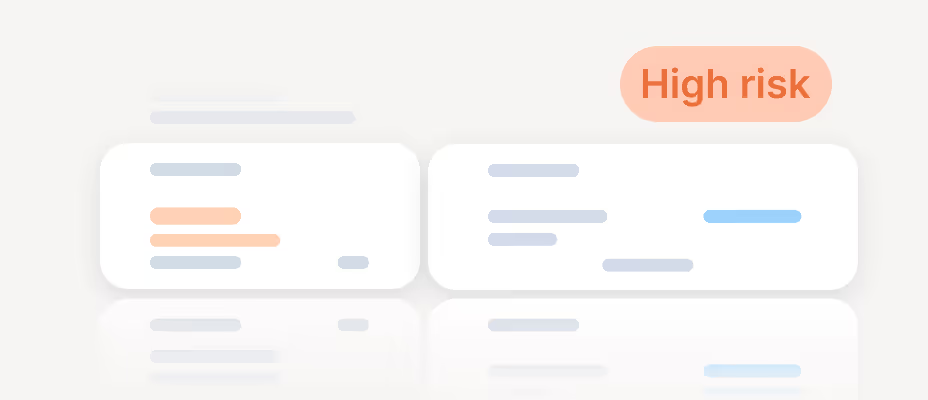
2.3If high risk
A higher-risk result means we found genetic markers linked to elevated T1D risk. This is not a diagnosis. If your risk is higher, all follow-up monitoring and support, including autoantibody testing, is provided at no additional cost.
Step 3
Ongoing support for high risk participants
 3.1FREE
1-on-1 genetic counseling
Online counseling with a board-certified genetic counselors
 3.2FREE
Autoantibody tests
Autoantibody test for follow-ups.
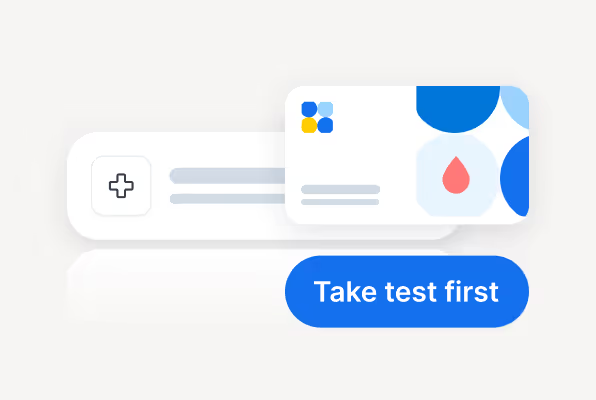 3.3FREE
Specialist referrals
If an autoantibody test is positive, the participant is referred to an endocrinologist.
 3.4FREE
Psychosocial support
learning content, one-on-one expert support, and peer support.
FAQs
Who should take this test?

Our program is specifically designed for individuals with a family history of type 1 diabetes (T1D) who want to understand their risk and access early monitoring. However, anyone who wishes to know their genetic risk may be tested, even without a known family history.
Can I register and order a test for my child?
Yes. Parents or legal guardians can create an account and register children for testing. After setting up your parent account, you will be prompted to add your child’s details. From there, you can manage their screening process, order kits, and view their results all in one secure place.
At what age should my child be screened?
Risk markers can be identified at any age, but many families choose to screen early (starting as young as age 0) to establish a baseline. More than half of children are diagnosed with T1D only after developing diabetic ketoacidosis (DKA), a serious complication. Knowing about elevated risk earlier can help families and their doctors stay alert to early signs.
Do I need a doctor's referral to get tested?
No. You can order our screening kits directly through our website without a physician's referral.
What are you actually testing for?
We analyze about 50 genetic markers — specific variations in your DNA — that published research has associated with type 1 diabetes.
These include markers in the HLA region, the part of the genome most strongly linked to T1D, and markers outside the HLA region, in genes involved in immune regulation and insulin production.
We look at which versions of these markers you carry and combine them into a single genetic risk score. That score estimates whether your inherited likelihood of developing type 1 diabetes is higher or lower than average.
What this test does not do:
- It does not detect type 1 diabetes, and it cannot tell you whether the condition has already begun.
- It does not identify disease stages.
- It does not tell you anything about your current state of health.
- Genetics is one factor among several. Many people with higher-risk markers never develop type 1 diabetes, and some people who develop it do not carry them.
This risk model was developed primarily using data from people of European ancestry. It provides meaningful results for people of other ancestries, but accuracy may be lower. We are working to expand validation across more populations.
T1D Scout provides genetic risk information — not a diagnosis or medical advice. Results should be discussed with your healthcare provider. This test has not been cleared or approved by the U.S. Food and Drug Administration.
How do I collect the sample at home?
Our kits are designed for ease of use. You simply use the provided swab to collect a saliva sample, place it in the secure tube, and mail it back to us using the prepaid shipping label. No clinical visit is necessary.
Is the test painful for children?
Our initial DNA screening is completely painless and uses a simple saliva swab—no needles required. The follow-up autoantibody test does require a small finger prick to collect a few drops of blood, but this is a quick process that can be done comfortably in your own home.
How long will it take to get my results?
For both DNA and autoantibody tests, you can expect results within 2–3 weeks after our lab receives your sample.
How accurate is the DNA screening?
In our pilot study of more than 1,000 individuals with a family history of T1D, those classified as 'higher risk' were about 10-20x more likely to test positive for multiple autoantibodies than the 'lower-risk' group. These are early research findings, to be presented at the 2026 ADA conference, and have not been independently validated.
What happens if I’m classified as “high-risk”?
We provide a complementary genetic counseling session to help you understand your results. We also offer ongoing autoantibody testing, coordinated with your healthcare provider and can help you connect with an endocrinologist if necessary.
Will I still need a blood test?
Yes
A genetic test cannot tell you whether type 1 diabetes has started. That requires a blood test for islet autoantibodies — the markers of the autoimmune process that leads to T1D. No saliva or cheek-swab test can replace it.
Our test looks at something different, and unchanging: the genetic likelihood you were born with. Your DNA does not change over time, so this is a one-time test that can be done at any age, without a needle.
What you do with that information is a conversation between you and your doctor. Whether and when to pursue autoantibody testing is a clinical decision — it depends on family history, symptoms, and other factors, not on a genetic score alone.
Important: a lower-risk result does not rule out type 1 diabetes, and it is not a reason to skip testing your doctor has recommended. If you or your child have symptoms of diabetes — increased thirst, frequent urination, unexplained weight loss, or fatigue — contact a doctor right away, regardless of any test result.
Is my genetic data private?
Absolutely. We use industry-standard encryption and secure servers to protect your information. Your genetic data is de-identified before analysis and is never shared with third parties or insurance companies without your explicit consent.
Will these results affect my health insurance?
Under the Genetic Information Nondiscrimination Act (GINA), health insurance companies in the U.S. are prohibited from using genetic information to deny coverage or determine premiums.
Still have questions?
We’re here to help! Please contact us at info@t1dscout.com and a member of our team will reply within 24 hours.